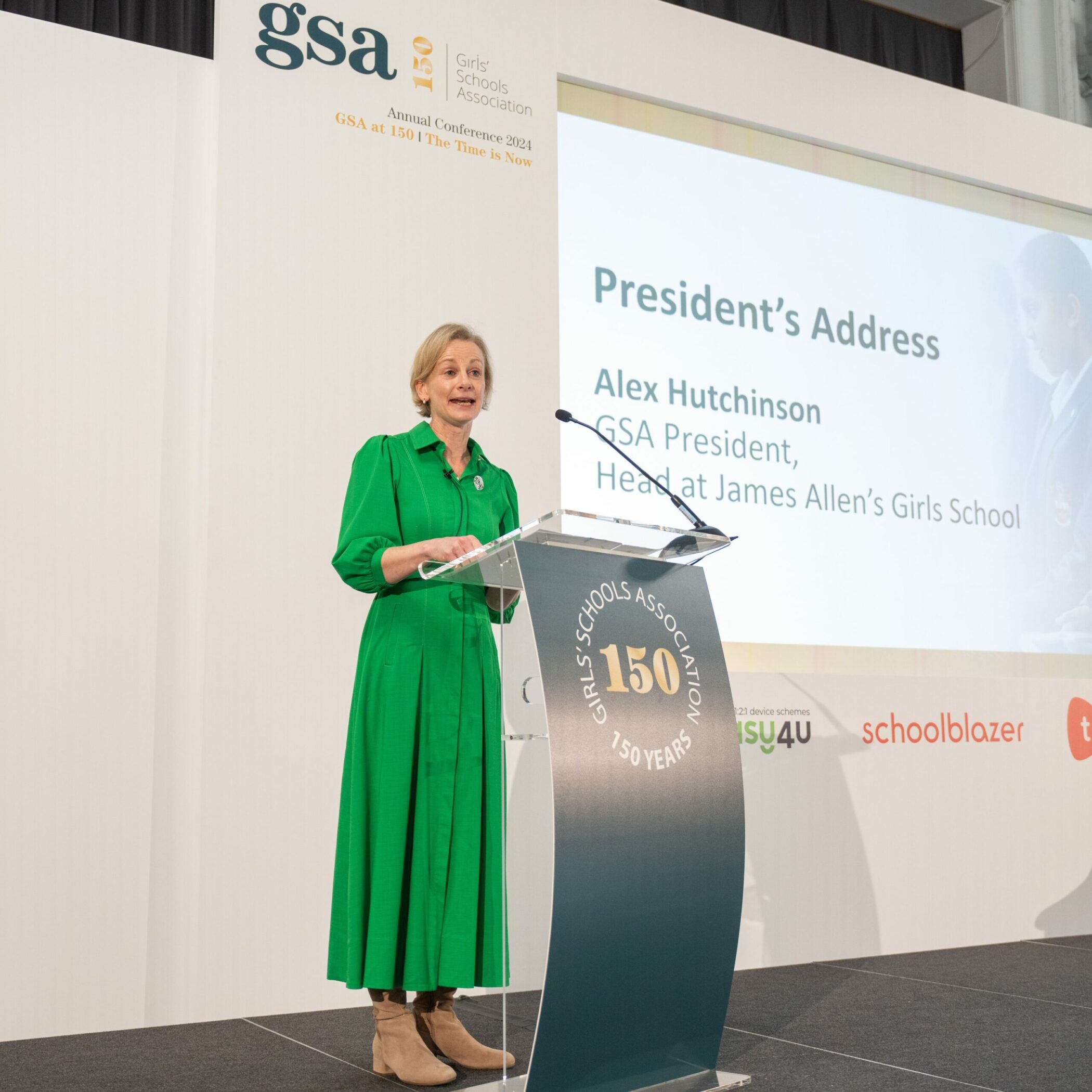
Alex Hutchinson in her 2024 Presidential address issued a rallying cry to headteachers of the association to stand up to protect young women’s opportunity for a girls-only education.
The Presidential Address, Alex Hutchinson
Annual Conference 2024 GSA at 150 | The Time is Now
Thank you to Donna for her welcome.
Welcome to members, new members, guests, and members of the press.
Thank you so much to our headline sponsors, easy4U, Schoolblazer, and Toddle. To our members, please do make the time to visit our sponsors and exhibitors, as their support is vital to ensuring that GSA can support all of you.
Welcome to our 2024 Conference – GSA at 150 – the time is now…because the time is now!
We have two days to celebrate a vision for the education of the girls in our schools; together, we have the chance to inspire and shape the future of our young people.
So, let’s celebrate the power and potential of this generation of girls; show them an education where there is no such thing as a glass ceiling; help them celebrate their precious individuality; and shout from the rooftops about the joy and vitality of our schools.
Let’s also take some time to think about our own leadership roles, and I have no doubt that our speakers will help to further inspire us with their messages.
My entreaty for the next two days is this: put down your phones, shut your devices, and leave the emails for as long as you can … this is the voice of someone who’s sat where you are … give yourselves some much-needed time for reflection and connection.
Let’s begin this year’s historic Conference with some storytelling.
One hundred and fifty years ago, in 1874, Frances Mary Buss and Dorothea Beale, the pioneering founders of the Girls’ Schools Association, challenged the historical status quo that denied equal access to education for girls. Their vision and activism created an association for the headmistresses of girls’ schools and provided schooling to young women to match that of boys’ schools; where girls had the chance to study a wide range of academic subjects, from Maths and Science to Latin and Greek – not just the traditional ‘lady studies’ (as they were quaintly termed at that time).
In the decades prior to Buss and Beale’s work, female literacy rates were still only 55% compared to nearly 70% for men, and careers for women were limited; becoming a governess was one of the few ways for women to earn a living for those of ‘gentle birth’.
The gendered nature of education could still be seen after the 1870 Education Act, with the curriculum for girls stressing ‘domestic skills’. In effect, compulsory education meant that working-class girls were educated primarily to a domestic role, with classes in laundry, home management, and needlework.
Together, Buss and Beale confronted these entrenched stereotypes and led the way to launch curricula that offered girls an almost identical education to that of their brothers.
They stood up for every girl, adamant that girls could and should rival boys’ academic achievements.
And how right they were; today, we see girls consistently outperform their male counterparts academically in schools – and this is particularly true of girls in girls’ schools.
Buss and Beale galvanised educational policy so that young women could start living lives of learning. By founding Queen’s College in 1848, they tackled inequity in education. The impact was profound, with ex-Queen’s students dominating many areas of feminist development, for example, Sophia Jex Blake, one of the first practising English doctors, and Gertrude Bell, the archaeologist and political officer.
Thanks to Josephine Kamm’s excellent biography, we also know something about the character of Buss and Beale. Buss didn’t approve of teachers being idolized by pupils and wanted to encourage their individuality and independence; her advice was: “The quickest way to stop that sort of behaviour is to let the girls get to know you. Once they see you as you really are, they will stop idolising you.”
Perhaps Buss and Beale were the original proponents of anti-perfectionism? And it is with pride that we stand upon their shoulders today; their vision lives on in us.
As I look out here – to this fantastic group of Heads gathered – what a vision it was, what legacy was created – and what an extraordinary privilege we have in our roles to continue that legacy of empowering the young women in our schools to embrace lives of learning and leadership.
Of course, we know that girls’ schools weren’t created 150 years ago.
1609 – Mary Ward founded the Society of Jesus, which numbers St Mary’s Ascot (where I have had the pleasure of working previously) amongst its family of schools. Mary Ward, with extraordinary clarity of vision, told us that ‘women in time will come to do much’.
This is just a snapshot of the schools we represent … and Mary Ward was right: women have come to do much.
Today, I will cover a range of issues from female leadership, via the strength of girls’ schools and on to the future, with all it holds for us.
Let me take us back to May 2016. Sixteen of us gathered in Stratford – it was the first meeting of the mighty GSA Class of 2016. Within a couple of sessions of that brilliant New Heads course, I was informally elected Head Girl, Ricki became Social Secretary, and Liz took on controlling the air conditioning. Roles which all remain relevant today. A group of 16 brilliant Heads to be. And not forgetting our friend, Emma, who will never be forgotten for the light and love she showed us all. We were bright-eyed and bushy-tailed. Innocent. We sat open-mouthed in the first session about employment law; none of us knew a single answer.
Fast forward a year later to New Heads Part 2. We were delighted to be reunited; we looked a bit older. A bit more worldly-wise. And we knew many more answers to the questions.
Fast forward to now – this year would be New Heads Part 10 for us. At some point, I suppose we’ll drop the ‘new’ from New Heads. But my reason for mentioning this fabulous group is to allow us all a moment to look around the room, share friendships, make new introductions, share a moment of strength and solidarity for the leadership roles we wear, to remember to thank those who support us – our teams in school, our PAs, and our families – and reflect on the extraordinary opportunities that our collective leadership provides for more than 100,000 students currently educated in GSA schools in the UK.
So, here’s a question. How many of us have experienced this conversation at an Open Morning in our school?
Prospective parents: “I’d never really considered a girls’ school; my daughter has been in a co-ed school since Reception; a friend told me to come and have a look at (insert name of school here) and … well … it’s not what I expected at all. It seems so … natural, so … relaxed, so … so much fun.”
Head: (silent fist pump) Another girl secures the best possible life chances.
But parents are arriving at a turbulent time for independent schools. As Pericles said, ‘Just because you don’t take an interest in politics, doesn’t mean politics won’t take an interest in you.’
We are at a defining moment in girls’ education. Girls’ schools play a pivotal role in creating a more equitable world; the very foundations of GSA are based on civic duty. Our schools have always been at the forefront of raising opportunities for young women through education.
The government’s VAT policy has the potential to have a seismic impact on girls’ life chances; it is forcing stark and unfair choices upon hard-working families.
I’m certain our speakers have faced challenging times too; General Sir Roly Walker will be able to shine a light on strategies for times such as these as he speaks about the value of leadership through service. I have no doubt that Mandy Hickson, former RAF fighter pilot will bring her own clarity of thought to the decision-making we face at times such as these.
Education is an emotive issue; understandably, feelings are running high, but we know who we are. As members of the GSA, it is right that we stand up and fight for independent girls’ schools so that our young women are still offered the freedom of choice to access an outstanding education, built for them. The hand of the Independent Schools Council has been forced to initiate legal action; it is not a decision that has been taken lightly, but it is right that we hold our Government to account.
This is a powerful moment. Our predecessors worked so hard to create the architecture of girls’ schools, and we will continue to advocate for a complete education for girls.
We know how important it is that as many girls and families as possible come to learn in our schools from every background. We know we advocate for families across the socio-economic range to have the choice to educate their daughters in our schools, and our transformational bursary provision makes this a reality.
We know we have built meaningful relationships in our local communities.
In my own school, over 140 Senior School students receive significant fee assistance. Our Y10 students volunteer their Saturdays to help local Y3 students with their literacy. Our Southwark Schools Learning Partnership is a cohesive group of 18 independent and state schools sharing best practices, training the educational leaders of the future, hosting careers fairs, and sharing student-led projects.
You will, of course, recognise this as a story repeated across the GSA; our schools spend £146 million on fee assistance each year, transforming the lives of thousands of students. And we know from research that the vast majority of us are proudly engaged in mutually beneficial partnerships with neighbouring state schools.
We are steadfast in this mission. Our communities can rest assured that we are doing everything in our power to hold the hands of the families already in our schools, and we will continue to support those new families who want to join us. We will continue to cherish our partnership work within our communities.
However, we are clear that no political decision should adversely impact young people. It is unthinkable that any girl in any of our schools feels her educational choice has been limited.
150 years ago, our founders forged positive educational reform to shape girls’ education and we, like them, want to work in partnership with the government.
We invite government ministers to think again. To come and see first-hand our schools’ excellence, passion, and care in action; to come to understand our purpose, and power to change lives. Our schools have always driven innovation and best practice, and these should be harnessed to create sustainable change across the educational ecosystem.
We want the best for every girl.
So, how best can we help unleash the talents of our girls? The current generations join a long line of young women hungry to take advantage of the same opportunities. Well, why shouldn’t they?
Every generation has had its fair share of unhelpful stereotypes: baby boomers are workaholics, millennials are lazy – sound familiar?
And, we all know that it is claimed that Gen Z are: ‘snowflakes who are overly sensitive and fragile.’
They are now joined by Gen Alpha who, we are told, are socially isolated and lack resilience because they have grown up in a risk-averse environment.
As experienced educators we know the truth bears no resemblance to these lazy stereotypes. Specifically in our girls’ schools, we harness, hone, and honour the talents of young women so that they can grow into the stateswomen of their own lives.
We equip them with the scaffolding, and provide them with the responsible counsel they need to live life well.
Over our conference we’ll hear more on this from Professor Paul Redmond as he reflects on generational differences and takes a closer look at how we can best prepare our students for future careers.
Deloitte sees that the future of work will ‘call for a return of the Renaissance figure’; a person of many talents and interests, fusing four key skills:
- Digital mastery
- Comfort with data
- Skills in business and management
- Creativity
There couldn’t be a better fit with the innate character and talents of our students.
Stanford scholar Roberta Katz provides key insights into Gen Z, emphasizing that they are highly collaborative, self-reliant, and pragmatic, able to build bridges through inter-generational dialogue.
Gen Alpha are just as well-placed for the new future and ‘will have access to more information than any other generation gone before’. Globally conscious, engaged citizens, who have already been exposed to issues like climate change, and social justice; who are adept and able to influence culture, technology and society with an agility that gives them the edge in a fast changing world.
But whether Gen Z or Gen Alpha, we are here in our schools helping them to thrive.
We understand the promise that they bring to the world. We understand how to design a curriculum that works for them.
When was the last time you sat in a room for 2 hours and wrote out your knowledge in response to a series of fixed questions? Do we expect the young people in our schools to be judged in the workplace by this skill? The brave new world has arrived.
It is time for us to work with a broader definition of learning and move towards an education that respects rigour yet also embraces the skills that are fit for the modern world.
The World Economic Forum future of jobs report 2023 tells us that the top 3 fastest growing jobs are ‘AI & Machine Learning specialists, sustainability specialists and Business Intelligence analysts’.
But interestingly, amongst their top 10 ‘on the rise’ skills sit ‘curiosity & lifelong learning, resilience, flexibility and agility.’ The very human skills that our schools champion so much.
Our schools are leading the charge and are at the forefront of giving equal focus to a breadth of subjects; we place a premium on fearless learning to stretch every young woman from the academic to the sporting, from the civic to the creative.
We encourage full commitment outside of the classroom, knowing the lifelong skills that are realised through co-curricular opportunities.
We are reducing a fixed number of GCSEs to allow focus on enrichment courses; learning for learning’s sake. PPE, sustainability, story-telling, civic discourse – allowing our girls the space in the curriculum to relish their curiosity of thought and develop their skills. Our digitally enabled curricula help blend the traditional and contemporary; curling up with a book in the library is still a comfort for many, but now it’s a change of scene from collaborative project-work on their devices, rather than a break from rote learning.
Our members’ schools are already working in so many innovative ways, helping lead UK education as a whole.
As a result, the data are compelling. We know that:
Our Girls’ Excel Academically
- Girls in girls’ schools consistently achieve better grades in all subjects and outperform girls in other kinds of schools. They are 2.7 times as likely to take Further Maths A Level; and more than twice as likely to take Physics and Computer Science, compared to girls in other schools.
Our Girls Conquer Stereotypes
- Our girls are the driving force behind creating greater peace in the world for everyone. They act as positive agents of change. They are the influencers of society, rather than the influencers of tik-tok trends.
Our Girls Play the Most Sport
- and for the longest time in comparison to girls in other kinds of schools. Our girls can relish their physical prowess and the simple joy of playing sports because they feel free to.
Our Girls Believe In Themselves
- Data reveals that our girls generally possess higher mental toughness scores than those in other schools which helps them to grow into capable, and self-assured young adults.
- Perhaps our schools will help end the eras of professional self-doubt of women; a 2019 Harvard study found that women with 8 years of programming experience are as confident in their skills as their male counterparts with only 1 year of programming experience. What held women back was not their actual ability to do the work, but rather the lack of confidence.
- It is in our schools that students are less likely to let their doubts stop them. If this helps banish imposter syndrome, then so much the better.
Just like our founders, our students are activists and trailblazers who continue to challenge the status quo.
And we are making meaningful progress.
- Worldwide, women hold one in every four parliamentary seats.
- In the UK, women now make up 41% of the House of Commons, up from 35% in the last Parliament.
- Women’s and girls’ football is seeing record growth. The number of women and girls playing has increased by 56%, and football is now officially the biggest female team sport in England. I’m sure Lucy Pearson, Director of Education at the FA will be able to tell us more about this later in her ‘Athletic Leadership’ keynote.
There is much to celebrate here and, while we roar with the Lionesses, it is through the collective efforts of women (and those who walk in allyship with them) that so much important progress has been made. Allies such as Andy Murray who, after hiring Amelie Mauresmo as his coach, said “It’s quite amazing how few female coaches there are across any sport. I didn’t realise that Amelie would find herself up against such criticism and prejudice. The staggering thing was that she was slated every time I lost, which is something my former coaches never ever experienced. It wasn’t right.’
At last year’s Conference, at the quiz night (which my team didn’t win) was a question about the connection between a series of films. The link turned out to be the films that scored highest in the Bechdel Test. For those not familiar with this, it is a test to measure the representation of women in film and other fiction. The test asks whether a film features at least two female characters who have a conversation about something other than a man. Alongside such highlights as Alien, Hidden Figures and Frozen, just imagine how highly the conversation in our schools would score on the Bechdel Test.
In our schools, young women are willing and able to take their rightful place alongside men as leaders.
How do we measure the success of our schools in delivering this opportunity? Well, aside from the data driven research led so skillfully by Donna, let’s highlight the leading women, alumnae of our schools, who are living these lives now. Here are just a handful: those in intelligence and activism like Dame Stella Rimington and Soma Sara; business leaders like: Debbie Wosskow OBE and Sue Anstiss OBE; academics and scientists like Dame Mary Beard, and Giovanna Mallucci.
Perhaps the greatest measure of our impact is the collective expectation of the girls who come through our schools that this is how life should be. We value their precious individuality and encourage them to act as beacons of hope for every girl in the world. It is vitally important that we pay this hope forward, especially for women and girls in countries where education is cruelly denied to them.
I’m often pulled to Viola Davis’s quotation: ‘Do not live someone else’s life and someone else’s idea of what womanhood is. Womanhood is you.’
Womanhood is you.
This is the success of our schools. Allowing young women to be themselves, to excel as themselves, and to act as role models for how a woman’s life can be lived well.
Our schools challenge unhelpful stereotypes and tropes that don’t serve them well – most recently Trad Wives. Our schools are anti-perfectionism. It is through engaging in life in all its messiness, in the classroom and beyond, that they can feel confident to easily spot and call out misinformation; learn to disregard air-brushed perfection for the confection that it is; have the strength to speak up against the misogyny baked into wider society.
The British Social Attitudes Survey shows us how ideas on gender roles have changed. In response to the statement “a man’s job is to earn money and a woman’s to look after the home”, in the mid 1980s, 48% of respondents agreed. In the 2023 survey, just 9% agreed. But still – that feels like 9% too many!
However, despite our progress, darker challenges for women in society persist. For the past nine years, with grim predictability, MP Jess Philips has stood in the House of Commons and read aloud a list of the women killed by men in the previous 12 months. This year Jess Philips spoke for all of us when she said she was ‘tired that women’s safety matters so much less … than small boats’ in parliament.
There is still a great deal to do. But every leadership role filled by a girl allows her to reach a helping hand to those that come after her.
This sets the right precedent for how the world should be. Let me acknowledge here the very important role that our brilliant male GSA Heads play in our schools. We walk alongside each other in friendship and purpose.
There is still so much work to do – progress is not parity. In the world of work, McKinsey research reveals that there is a broken rung in the corporate ladder: for every 100 men who received their first promotion to manager, there were just 81 women. Simply put, men outnumber women at every level.
So, no, none of us here is cavalier enough to think our work is done.
This is a call to arms for us to stand up in support of girls’ education. Are you with me?
We must approach each new challenge with the same fervour as Miss Buss and Miss Beale to command the next 150 years together with the focus and excitement it merits.
Billie Jean King once said: “We all stand on the shoulders of those who came before us, and we all have an opportunity to share our lives, our experiences and our vision for the future. Each of us is an influencer, and to all the athletes who truly have a platform, let’s continue to use the power of our voices and our actions to inspire others.”
To GSA, its past, present, and its future, and to all of us who make it what it is – the time is now!