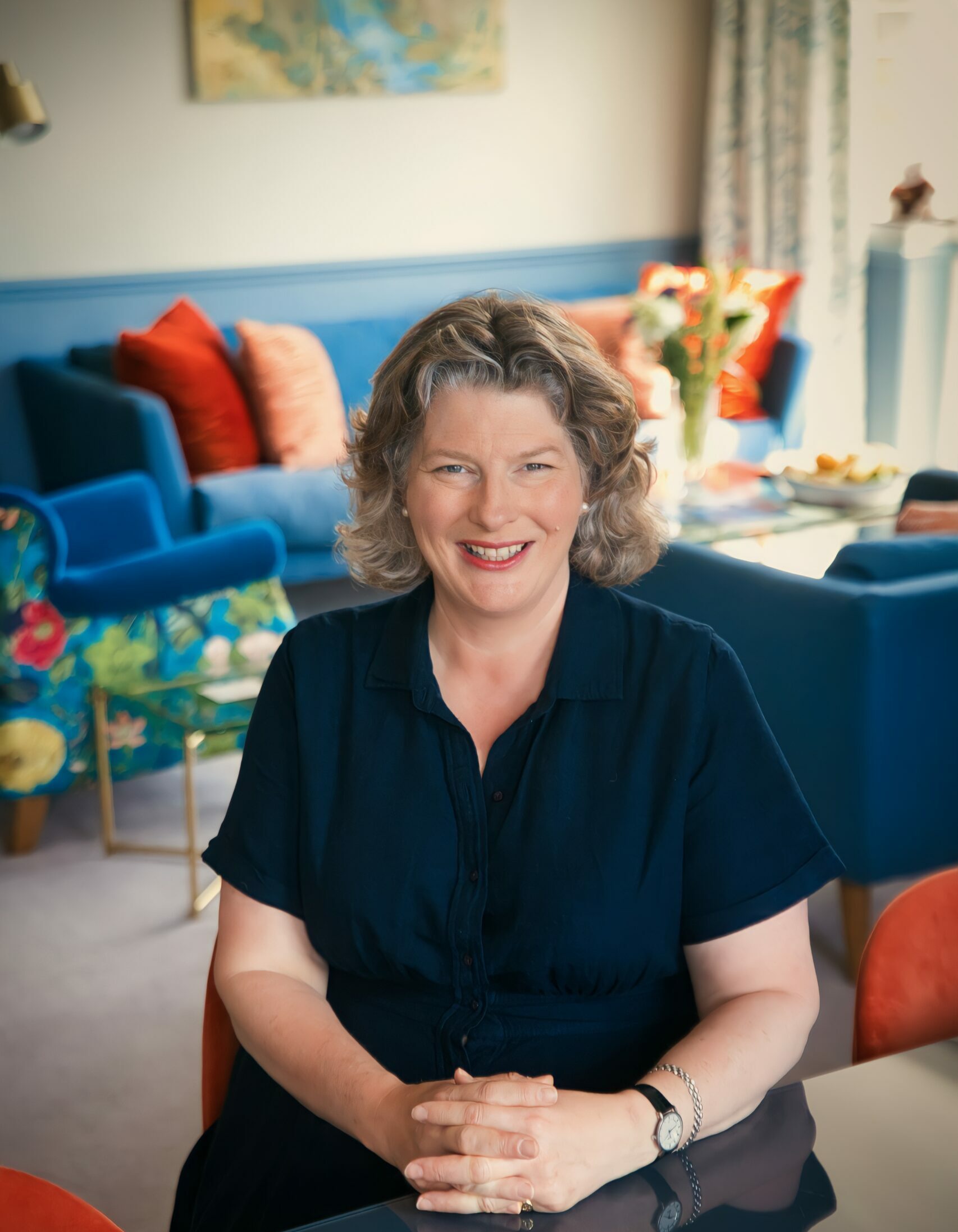
Lindsey Hughes has spent her Presidential year urging girls to be 10% braver – to catch compliments and never duck them. Lindsey has always been clear that the world needs more fearless women and girls.
Girls are out-performing boys at every stage of school, university and beyond – and somehow feeling less sure of themselves than boys. Ministers have announced anti-misogyny lessons, a new helpline and fresh RSHE guidance; Westminster is locked into a much-contested debate on the ban of social media for under-16s; and Laura Bates warns that AI is busy reinventing sexism faster than any curriculum can keep up.
As her presidential year draws to a close, we sat down with Lindsey Hughes, Headmistress of Channing School for her unvarnished verdict – on the panic, the politics, and what she believes comes next.
- You opened your Presidency with a stark line: the world needs fearless young women. A year on – having watched the news, the algorithms and the politics – is the world getting braver about girls, or are we asking them to be fearless because everyone else is losing their nerve?
The world is not necessarily getting braver; in fact, it offers us no end of menace. Our news feeds are full of political division and social fractures at home, while war, disease and instability are rife beyond our shores. This is compounded by an online culture that peddles aggressive misogyny as a lucrative commodity. My fellow Head, Fionnuala Kennedy at Wimbledon High School, GDST, has described this as a battle against the ‘monetisation of loneliness’. In her view we live in a culture driven by commercial tech platforms that actively encourage, reward and amplify rage-bait, performance extremism and social polarisation, simply because extremity of thought generates clicks, engagement and massive financial cash flows. This online world peddles an open, aggressive misogyny that is treated not as a fringe ideology, but as a lucrative commodity. It runs all the way from anonymous internet trolls and popular podcasters to wealthy business moguls and powerful politicians who model the exact regressive world views that we, in school and at home, are working tirelessly to dismantle.This is precisely why the case for girls’ schools has never been more urgent, more necessary or more vital to sustain. An all-girls school like Channing provides an essential space for those voices. It is an environment of empowerment, psychological safety and uncompromised ambition. - You champion self-compassion alongside ambition. Have we simply added ‘be confident’ to an already impossible list of expectations of our girls?
I recently came across the concept of the ‘Triple Bind’, developed by psychologist Dr Stephen Hinshaw, which I recognised immediately. Coined in his seminal research, the Triple Bind describes the impossible, contradictory set of expectations placed on adolescent girls in contemporary society:First, they must be traditionally nurturing, empathetic, and compliant caregivers.
Second, they must be hyper-competitive, high-achieving academic superstars and superb athletes.
Third, they are expected to accomplish all of this entirely effortlessly while looking perfectly attractive, stylish, and composed.
We all know it is a physical, emotional and psychological impossibility to fulfil these three demands simultaneously. And yet, our girls, young women, and even adult women, find themselves under pressure to be, and do, everything. Enough! At Channing, we refuse to be defined by what Dr Hinshaw calls the “false idol of perfection”. Rather, we know that confidence is bravery. Confidence comes from each incremental moment of taking a risk, of trying something new, of being 10% braver and succeeding. We provide our students with a platform to do just that.
- The headwinds facing this generation of girls are new and fast-moving. Where do girls’ schools have a real edge over other educational spaces to address these?
Girls’ schools have a distinct edge because they place girls at the absolute centre of everything, ensuring they are never relegated to the sidelines. We provide a tailored education, where everything is designed specifically for how girls learn best. We create a supportive community where girls can engage in civil discourse and challenge ideas openlyAbove all, we help girls find their authentic voices and understand their intrinsic worth long before they enter the wider world.
- In your Presidential address you told girls to catch compliments like a rounders ball. This is a lovely image – but is the problem really that girls won’t catch it, or that the world keeps refusing to throw it to them?I love Caitlin Moran’s analogy of the rounders’ ball. In her book she suggested that when a girl dodges a compliment, she lets the whole team down. We can certainly help girls – who are conditioned to be self-effacing to the point of invisibility – claim their strengths and blow their own trumpets
However, the world contributes to the problem by enforcing rigid, regressive worldviews and unfair pressures. The online world openly commodifies misogyny, while modern society constantly attempts to cast young women into an impossible, restrictive mould. Girls must be empowered to reject these external expectations, protect their unique individuality, and refuse to give their consent to be kept down.
- It took Adolescence to move ministers. What does it say about the world that fiction, not girls’ and women’s own voices, finally forced the conversation?I think it’s fair to say that young women’s voices are routinely ignored by policymakers. For example, take the government’s under-16 social media ban. I’m not surprised that 90% of parents saying they want a ban has precipitated the Government’s action – but I also note that the young people who responded to their consultation offered insightful and practical changes that could make social media a better place for them. I’m disappointed – but again, not surprised – that those voices have not been heard as loudly as they should be.
- “Be 10% braver” is your call to girls and the headteachers. As you hand over, what’s the one thing you wish you’d been braver about?Actually, I’m pleased with what we have achieved this year. We have a fabulous new Chief Executive, Jeanette Cochrane, who is full of energy and excitement about the mission of the GSA. It was great to lead that recruitment process, and now be working on strategic developments for the future of the Association.
One piece of bravery that really paid off was to invite the then Minister for Safeguarding, Jess Phillips MP, to speak at the GSA Conference last November on the Government response to violence against women and girls. I found it fascinating that it was only when I introduced her as an alumna of an all-girls’ school that she mused out loud at the start of her speech that she had never really thought about the impact this might have had on her outlook on life!
- And finally, what’s next for you and is there anything you didn’t get round to saying that you wish you had?As my presidential year with the GSA draws to a close, I look forward to spending more time back at Channing focusing on our strategic ambitions – and having a teaching timetable again! I have really missed that classroom contact with pupils.
In my first speech to my fellow Heads I quoted this poem, Legacy by Rupi Kaur:
i stand
on the sacrifices
of a million women before me
thinking
what can i do
to make this mountain taller
so, the women after me
can see fartherI think my final words would be for the girls we teach up and down the country and all the staff and leaders who work in our wonderful schools, to remind them that they are the authors of the next chapter and can make the mountain taller. I’d urge them to reject the Triple Bind and the false idol of perfection, and be 10% braver, embracing the lessons that come with making mistakes. Above all, be ambitious, remain resilient, and walk out into the world knowing exactly what you are worth.
Lindsey Hughes is Headmistress of Channing School and served as President of the Girls’ Schools Association for 2025-26 academic year.