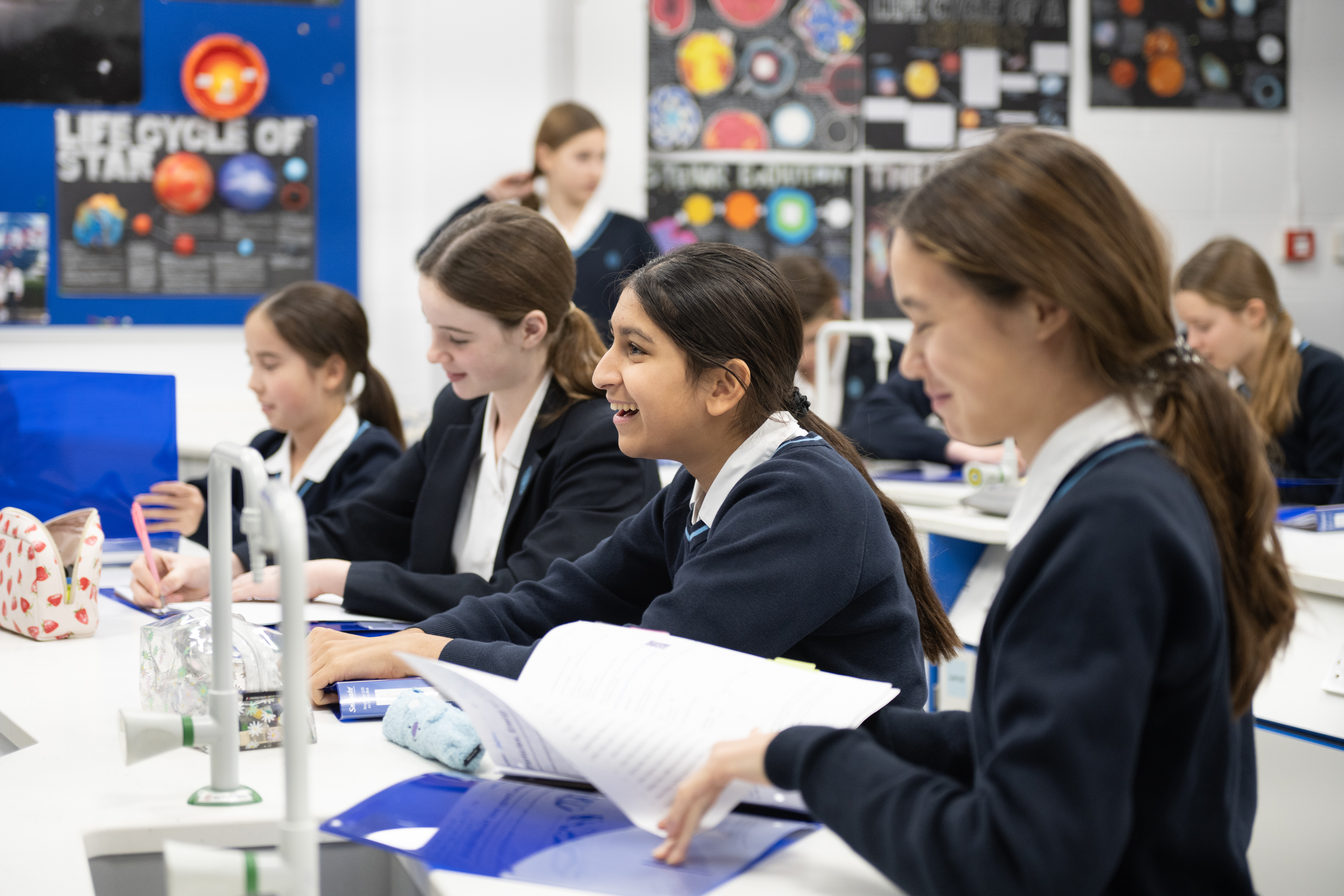
Reading about the theme prompted me to reflect on what science looks like at FHS. While diplomacy may feel a long way from a school science lab, the idea of people with different backgrounds, interests and expertise coming together to better understand the world is something we see every day.
One of the most rewarding aspects of teaching science is seeing where pupils’ curiosity takes them when they are given the opportunity to explore questions that interest them.
In Sixth Form, every Year 12 scientist researches and delivers a presentation on an area of personal scientific interest. Our current Year 12 students are beginning that process now, and each year the topics prove just how varied scientific curiosity can be. Recent presentations have explored how animal cells acquired mitochondria, what can be learned from the Apollo missions as NASA prepares for Artemis, and even how microbes can be used to clean and preserve Michelangelo’s David. What begins as a question about a famous sculpture quickly becomes an exploration of microbiology, chemistry, art history and conservation.
The same spirit can be seen in the independent research undertaken by pupils across the school. One of our Year 11 students is currently developing a CREST Award project exploring what makes molecules scented. Her initial research has already led her into chemistry, biology and psychology as she investigates how molecular structure influences smell and why particular scents can evoke powerful memories. It is a wonderful example of how scientific questions rarely respect the boundaries between subjects: understanding something as familiar as smell requires insights from chemistry, neuroscience and psychology alike.
Perhaps one of the most striking recent examples of science bringing different ideas together came from two Sixth Form students, Mia and Nina, who entered Imperial College London’s Science in Medicine competition. They focused on a challenge faced by many people undergoing treatment for metastatic breast cancer: how treatment response might be monitored more easily and more frequently. Drawing on biology, chemistry, engineering and data analysis, they developed a proposal for a wearable monitoring device designed to support patients and healthcare professionals alike. What impressed me most was not simply the scientific knowledge involved, but the way that knowledge was brought together in service of a shared human challenge.
Connections between disciplines begin much earlier in pupils’ journeys through the school. During a recent STEAM project inspired by the year FHS was founded, pupils considered what it might have been like to be an artist in 1881. Their discussions quickly led to another question: where did artists get their paints? From there, they explored the chemistry of natural pigments, compared tempera and oil paints and discovered how scientific advances transformed the colours available to artists.
Opportunities beyond the classroom often provide the spark for further curiosity. Visits such as those to CERN allow pupils to see science on a global scale. There, researchers from across the world work together to design experiments, investigate fundamental questions about the universe using the Large Hadron Collider and analyse data collected by enormous detectors surrounding the collision points. It is a powerful example of what can be achieved when people from different nations and disciplines work together to pursue a common goal.
These examples represent only a small snapshot of the work taking place across science at Francis Holland. Every pupil’s interests take them in different directions, and one of the joys of teaching is supporting those journeys and seeing the unexpected connections they discover along the way.
As we look ahead to the development of our new STEAM Centre, I am excited by the opportunities it will create for even more pupils to pursue their curiosity, collaborate with others and explore the questions that matter most to them.