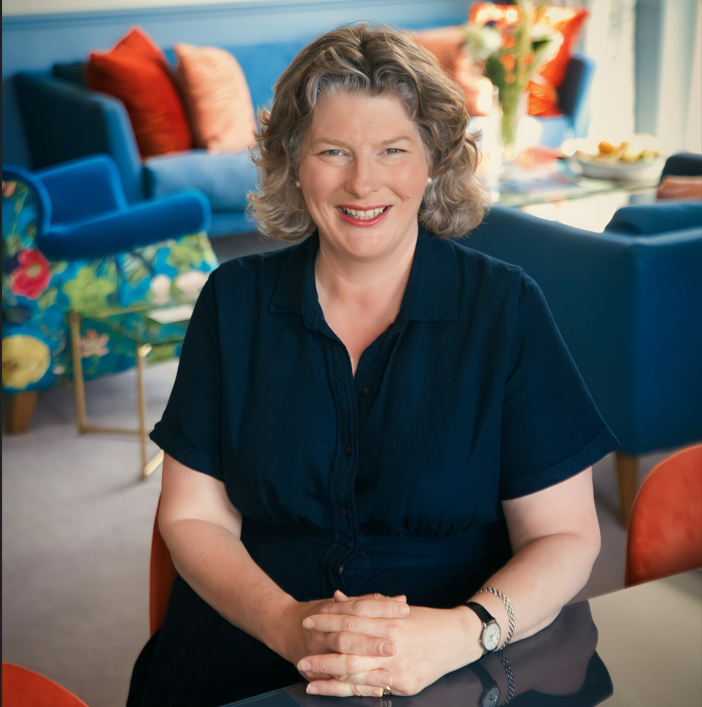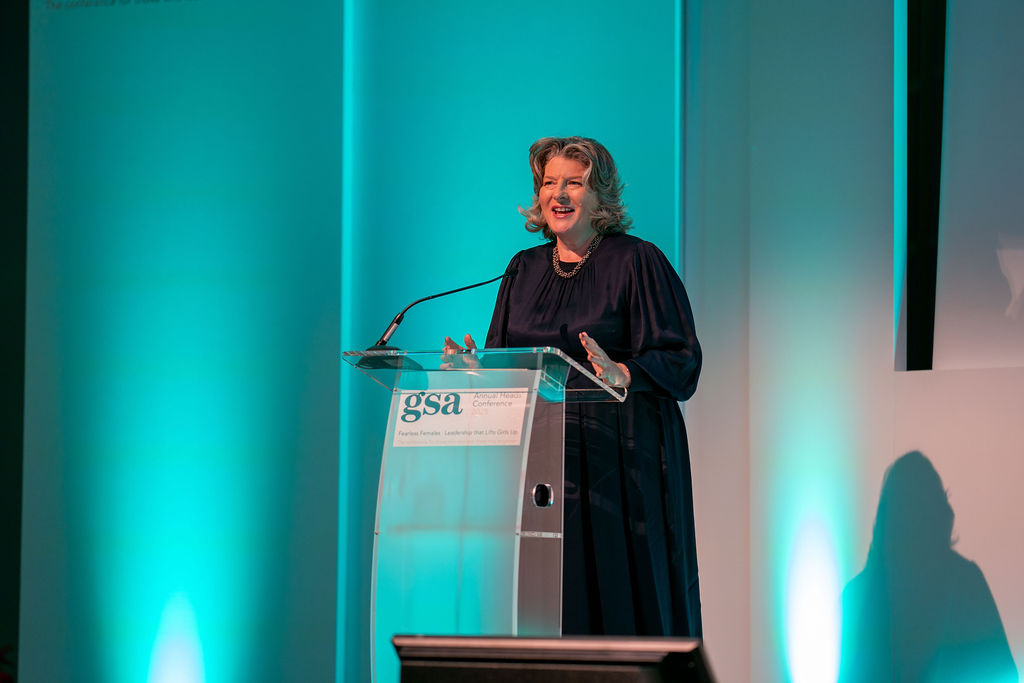
The President’s Address to the Girls’ Schools Association Heads’ Conference 2025
Fellow Heads, friends, guests and colleagues, it is a privilege and an honour to speak to you this morning as President of the Girls’ Schools Association for 2025–26, and to welcome you to our conference. It is wonderful to have so many full and associate Members here, representing the diversity of our wonderful Association. Small, large; urban, rural; day, boarding; prep, senior, all-through; state, independent; highly selective or not at all; we are all bonded by our shared belief in the power and importance of an all-girls education. I am so very grateful that you have taken the time to come to Conference this year, to join together to reaffirm our common purpose and to find collegiality, practical tips and camaraderie with one another. One of the joys of GSA headship is its collegiality and support network and to those of you for whom this is your first Conference – welcome!
Welcome also to our guests from our fellow Associations, including Jo Rowley, President of the Association of School and College Leaders, with whom I was privileged to serve on ASCL Council for the last four years. Welcome also to the press who are with us today and tomorrow morning. I should also mention here those members for whom this is your last Conference as GSA Heads. Thank you so much for all you have contributed to the Association and to the girls in your care: we wish you the very best for your next chapters. My request to everyone is that you should please make it your mission during the coming 48 hours to speak to three people you have not met before and expand your circle of fellow Heads. I hope you will be inspired by each other and return back to your schools refreshed and ready to carry on your invaluable work.
Over the next two days I am excited to have invited speakers whose work I really admire to share their thinking with us, including Dr Kaitlyn Regehr, whose work on digital diet we helped to research at my school; Evelyn Forde, former girls’ school Head, former President of ASCL and author of the manifesto Herstory; and Vivienne Porritt, co-founder of #WomenEd, who first asked that simple question back in 2015, “What would you do if you were 10% braver?”. Tomorrow we will be joined by a Government Minister, speaking on the topic of Championing Women and Girls’ Safety in a Changing World. And flying the flag for 10% braver students everywhere my own Head Girls, Annie & Natasha, will take to the stage this afternoon with journalists Hugo Rifkind and Lucy Manning to explore the world in which our girls are growing to be young women, and their perceptions of that future.
None of this would be possible without our headline sponsors, Easy4U and Vectare, who I must thank for their generous support. So often at Conference it is the time between sessions spent perusing the exhibition which provides the spark of new ideas to take back to our schools with us, and I have no doubt that this year’s sponsors and other exhibitors will do just that. Please do take the time to explore.
In the months of planning that have gone into these few days, dozens of you have offered me a listening ear and your thoughts about what Conference should include, for which I thank you all. However, there are three people who need particular mention. Firstly, Helen Hill and Jenni Gladman have been extraordinary in their detailed planning, logistical oversight and kind support of me. Helen stepped into her new role with planning already well underway and picked it up seamlessly; Jenni has brought her cheerful demeanour to every conversation and kept me focused as we brought the schedule together. The unsung hero of the piece is my remarkable PA, Hanna Fathers. Her creativity, humour, love of spreadsheets and ability to play Tetris with my calendar are part of the reason I felt able to take on the role of President in the first place and she has used them all in the preparation of this Conference. Helen, Jenni and Hanna, thank you all so very much.
Finally, my huge thanks to Donna for her opening remarks and, of course, for her leadership of the GSA over the last five years. We will be saying a formal thank you to her at the AGM tomorrow afternoon but for now, Donna, please accept our warm appreciation for all you have done for us in your role and I hope that you will enjoy your final conference as our CEO.
Our Conference this year is held under the banner Fearless Females: Leadership that Lifts Girls Up, a conference for those who lead and those they empower. I chose that title because I think it speaks to our core purpose, our shared mission and the foundational belief that unites every school in this association – both for the students in our care and the remarkable people who staff our institutions.
It brings to mind our trailblazing forebears: in our 151st year we can reflect proudly on a rich legacy for the GSA. On 22 December 1874, the Association of Headmistresses first met at Myra Lodge in Camden. Dorothea Beale took the Chair and Frances Buss became the inaugural President, remaining in that post until 1894. The association brought women school leaders together “to know what we ought to assert and what surrender”, and it is on their shoulders that we stand today.
GSA schools are not just providing an education; we provide a unique space where girls hear a different narrative about their abilities, talents and potential as girls and young women. The power and purpose of an all-girls education lies in the simple, yet profound, fact that everything is designed for them. The curriculum, the extracurricular activities, the leadership opportunities – they are all for girls. In this environment, they are free from stereotypes about what girls can and can’t do. It gives every student the freedom to find and develop her individual talents and interests to the full by trying new things, repeatedly, until she finds the combination which best represents the person she is becoming.
This great education is also built on a sense of security and belonging. When a student feels comfortable being herself, she is free to learn and grow. This is where our schools excel. The evidence is compelling and paints a clear picture of an educational model that challenges, inspires and achieves remarkable results. The data is unequivocal: 95% of students at all-girls schools feel supported by their teachers, compared to 84% at co-ed schools. That 11-point difference is not a small margin; it represents a classroom culture of shared aspiration where girls can express themselves freely and develop higher-order thinking without the social pressures that can often stifle participation.
And our commitment goes beyond academic achievement; it is about character building. Not everybody’s experience of school is a happy one and I have made it my mission as a school leader to ensure that girls in the schools where I have worked hear the messages that no-one told me when I was at school. Above all I want our students to develop two key, interconnected characteristics that will serve them long after they leave us.
Firstly, the ability to celebrate their strengths. Our girls are often quick to brush off praise or achievement as luck or a fluke. We must teach them explicitly to stop. It’s not boastful to blow your own trumpet; it’s entirely right to take pride in a job well done. We want our girls to be able to say, “I’m good at this, I do this well,” without hesitation. This is the antidote to the perfectionism that too often holds young women back. We need to help our girls to understand their own strengths and the ability to celebrate them; to acknowledge praise and accept compliments. I have always enjoyed Caitlin Moran’s suggestion that girls should catch compliments like catching a rounders ball and that by dodging them we let the whole team down.
The counter to this is that they must learn and practise self-compassion. We know that girls can be prone to being far too self-critical and hard on themselves when things go wrong. However, they are brilliant friends, and will be the first to say to a classmate, “You’re great, it’s just a blip, you’ll do better next time” when things go wrong. Girls – young women, even adult women – speak to, and about, themselves in a way they would not dream to speak to other people. I want them to be as kind to themselves as they are to others about the things they can’t do so well, and be happy to live with those imperfections. It may sound obvious, but this self-compassion is not always explained explicitly or taught. It is the necessary foundation for resilience.
And of course, if we are to produce fearless females who are ready to lead, we must first ensure that our institutions are led by, and actively nurture, a fearless staff. Our mission extends to the women we employ, for they are the visible embodiment of what our students can become. We have a responsibility to ourselves and to our staff to share best practice, support one another and work together to improve our skills and competencies as leaders.
Many of you already know that I wear a badge on my school lanyard which simply says: “I am 10% braver.” That phrase is not just a call to action for our students; it is a profound philosophy for all of us gathered here. Because the truth, simple and sobering, is this: the world needs us, and our bravery as leaders of girls’ schools.
It is a sad fact that we face significant challenges. I know that all of us in this room are working daily against a backdrop of changing demographics, harsh economic realities and increased competition, making the case to sometimes sceptical parents about why an all-girls school is the best place for their daughter. We spend our time working out how to make efficiencies whilst also delivering the quality and depth of education that our schools are famed for – and always in good humour, with an open door for staff, students and parents, and an inspirational weekly assembly to prepare for.
It is no easy task but we lead anyway because we care deeply about our students and because the world is not yet equal. Our young women will go out into a world where they still need to meet challenges that are fundamentally rooted in injustice. We continue to face inherent misogyny, in real life as well as online, and violence committed daily against women and girls. Violence against women and girls is increasingly recognised as a public health crisis and human rights issue. In 2024 the National Police Chiefs’ Council described it as an “epidemic.” I am delighted that the Minister will be joining us tomorrow to tell us more about the Government’s work in this area. In just under an hour’s time we will hear from Dr Kaitlyn Regehr about her research, which has included a study exploring how young people in the UK experience sexual harassment and abuse though social media platforms. She and Professor Jessica Ringrose found significant gendered differences, for example that girls experience far higher pressure to send nudes, with 44% of girls agreeing with this, compared to 12% of boys, and that girls are six times more likely to receive unsolicited genital images.
We also contend with the stubborn gender pay gap and the lack of representation in professions, even as we celebrate milestones like the fact that, as of March 2025, over 50% of doctors are women for the first time. This year the European Equal Pay Day, the day of the year when women stop earning relative to men, is today. In the UK, it’s coming up in the next week or so, reminding us once again that on average women are working more than six weeks more each year for the same pay as men. Last year the gender pay gap in the UK had widened for the first time in three years. Likewise, only two weeks ago the BMA reported their research indicating that 41% of female medical students have experienced sexual harassment or assault, highlighting a “sexist and unsafe” culture in medical schools and clinical placements. Progress, maybe, in some areas, but not yet parity.
Our schools exist to provide the antidote: they are the agents of change because they create shifts: in thinking, opportunities, equity, confidence and culture. Our girls’ schools shape mindsets, disrupt old norms, challenge misogyny and send braver, bolder, young women into the world. Our mission is clear: we must champion the transformative power of all-girls education for our students, and we must be equally intentional about developing and retaining the powerful female leadership within our own staff. We are here to ensure that both our students and our staff have the space, the training and the confidence to be just that little bit braver.
Crucially, in a girls’ school, female leadership is not an ideal – it is the norm. 39% of girls opt out of leadership in their teenage years – but not in girls’ schools, where every position of responsibility is held by a girl. Think of the visible role models we create: the form captains, Eco Reps, Digital Leaders, Heads of House. At my school girls in Reception sit on School Council, preparing them for a school career of leadership which leads all the way to the Year 13 Prefect team, steering the school’s direction through their leadership of different aspects of school life.
But leadership doesn’t just come with a badge and a title. We’re also developing the entrepreneurial skills of girls leading Junior Dragons’ Den and Young Enterprise companies, putting our school productions in the hands of student sound and lighting teams, and, of course, giving every girl the chance to develop the leadership skills which come with playing sport. We know that sport participation in the UK lags well behind other countries and is particularly poor for girls, rooted in stereotypes from as young as six months.
The good news is that the GSA’s own research shows us that on average girls in girls’ schools participate in 25% more curriculum PE than the national norm. In addition, where nationally there is a 65% reduction in the time girls spend playing sport between KS4 and KS5, for girls’ schools this drop off is only 25%. The work we do in our schools changes girls’ perceptions of themselves, whether that is changes to kit such as those Carol Chandler-Thompson has made at St George’s in Edinburgh, or inviting sports bra company PEBE to do fittings in our schools – we enable them to stay physically active for longer and with that to learn more about themselves and their capabilities.
This approach normalises female leadership. We exemplify a “no limits” mindset that is especially transformative in STEM. With no such thing as “boys’ subjects” and “girls’ subjects,” our students follow their curiosity and choose them all. Is it any wonder that graduates of girls’ schools are 40% more likely than those from co-ed schools to pursue a career in engineering?
That’s because our schools are innovative, creative and progressive. We are equipping our girls for a future defined by digital mastery, data, business and management, creativity and the rise of AI and machine learning, as noted by the 2025 World Economic Forum report on jobs. We know that the best people who develop into leadership positions, those who are best prepared for an unknown world, are those who have universally applicable skills: perseverance, an ability to grapple with difficulty and cope with boredom, who have high attention spans and show teamwork, curiosity, comprehension, communication, critical thinking, creativity and empathy.
We teach our girls to engage with life in all its messiness and not to be put off when things inevitably don’t go to plan. Our entrepreneurial alumnae bear testament to just that. Last month you may have seen Cheltenham Ladies’ College alumna Sophie Emler with her business partner Rebecca Moule, landing investment in the Dragons’ Den for their app MatesPlace. Or Murvah Iqbal, alumna of Manchester High School for Girls, who was named in the Sunday Times 2025 Young Power List as co-founder of HIVED, a zero emission delivery service. Her company has raised over £11 million and works with retailers that include ASOS and Zara. Entrepreneurs need all those skills and it’s certainly messy to set up and run your own business.
This brings me back to the mantra of being 10% Braver. We know that girls, young women, and even adult women, can be held back by fear: fear of not being good enough, of failing, of what other people will think. The Leadership Circle’s most recent report reveals that female leaders frequently underestimate their skills and influence to a greater extent than their male peers. Furthermore, female leaders also describe themselves as “overloaded and overcommitted” to a higher degree than their male counterparts. Clearly those attributes I want us to develop in our students, of acknowledging their strengths and learning to live with their limitations, are just as important to us and to our colleagues in school.
We are coaching our girls now to overcome that fear, not necessarily by conquering it outright, but by asking ourselves, as #WomenEd suggests: If I were 10% braver, could I do this? And the answer, always, is yes. For younger pupils, it could be as simple as offering an opinion in class, committing an answer to paper without checking it first, or trying out a new club. From those incremental moments of taking a risk, of trying something new and succeeding, confidence is born. As a wise woman who’s sitting in this room once said, there’s no point in just telling a girl to be confident. Rather, she said, confidence is bravery. Confidence comes from each incremental moment of taking a risk, of trying something new, of being brave and succeeding. We give our students a platform to do just that.
A great example of this is our social impact work, which is so beneficial in offering girls and young women from all kinds of backgrounds and schools the very best opportunities that would not otherwise be open to them: young women like Ava Charlton, who seized the chance of a bursary place at Benenden and describes her time at the school as “life changing”. Ava took every opportunity to take part in school life, holding multiple leadership roles including Head of Student Voice, leading the student Social Sciences Society and being Model United Nations Deputy-Secretary General. Achieving four A*s, she is now in her first year at Durham University studying Social Sciences and still leaning into those leadership opportunities: she is Head of Publicity for the Winter Ball and Youth Officer for the Constituency Labour Party in the Weald of Kent. It’s probably fair to say that her leadership blueprint from her time at school looks set to be a habit for life! And we all have our own students’ stories that match this. Our independent member schools currently fund £164 million on transformational bursaries and fee assistance and we can feel rightly proud of the material difference we are making in young women’s lives.
The namesake of my school, William Ellery Channing, was a 19th-century Unitarian Minister in Boston. He wrote this beautiful sentence that encapsulates what we are trying to do: “Each of us is intended to have a character all our own, to be what no other can exactly be and do what no other can exactly do.” Our schools mean that girls grow into young women in an environment free from stereotypes, and by the time they leave our senior schools they are ready to step out into the world as confident leaders who know and like themselves. That’s no mean feat. A girls’ school is a launchpad where we equip them with the tools to be capable, strong and resilient women, who have no reason to compromise themselves or their dreams.
So, while there is a mountain for our girls to climb, we are giving them the ambition to take it on. In the words of Rupi Kaur’s profound poem Legacy, which I read to you at Summer Briefing in June and for which I am indebted to Eve Jardine-Young for introducing to me:
i stand
on the sacrifices
of a million women before me
thinking
what can i do
to make this mountain taller
so the women after me
can see farther
This is what I want for our students, that they should not be daunted to climb that mountain, and that their ambition once there should be to think only about how to improve it. We know that the world needs individuals who can understand and connect with others, who can build bridges instead of walls. Not all our girls will go on to be leaders of national or global significance, but we are preparing all of them to take charge of the lives that they choose to lead with confidence and skill and lean into leadership in whatever their sphere might be.
We know investing in female leadership reaps dividends, both morally and tangibly. Research from McKinsey & Co shows that companies with women in executive roles are 25% more likely to outperform financially. There are multiple studies which show that companies with diverse leadership teams, including women, report up to 25% higher employee satisfaction and retention. The McKinsey report, The Inner Game of Women CEOs, gives us the language for what the best women leaders do, the attributes our students see in us every day:
• They lead with purpose, not ego.
• They build relationships that are strategic and generous.
• They think big-picture without losing sight of execution.
• They lead with confidence and humility.
As we will hear from Evelyn and Vivienne this afternoon, we must be intentional about identifying, developing and promoting the female talent in our schools. We know that the need is stark. A study by the DfE revealed that, on average, male teachers attain headteacher positions more quickly than their female counterparts, with approximately 16 years of experience for men and approximately 19 years for women. While women make up nearly two thirds of the teaching workforce, in 2023 women still constituted only approximately 40% of headteachers. This indicates a persistent gender gap in leadership progression within secondary education, one that we, as the leaders of female-focused institutions, are uniquely positioned to redress.
We must formalise opportunities for progression and, while many of us have, we don’t have to build a leadership programme in our school from scratch. We can tap into our excellent existing GSA networks to help us with coaching and support, and encourage our staff to join organisations like the BrightLead Coaching programme, #WomenEd or the ASCL Women Leaders Network. We need wider opportunities for female leadership beyond the traditional promotion into middle and senior leadership, focusing on responsibilities that have a whole-school or cross-stage remit. Formalising secondments to SLT through project-based roles also exposes aspiring female leaders to whole-school strategy in a way that can only benefit their CV. Certainly I have tapped up female members of staff to apply for roles which they had not considered, or indeed talked themselves out of applying for: knowing and noticing our staff is vital.
Finally, we need to ensure that maternity does not derail our staff’s career development. According to an article in the Financial Times last month, “Women in the UK take a lasting earnings hit when they become mothers, losing an average of more than £65,000 over five years following the birth of their first child.” The Maternity Teacher Paternity Teacher (MTPT) Project offers CPD and networking for women and men during their leave. Most critically, we must challenge the outdated idea that leadership can only be full-time, being creative and open to part-time leadership roles and flexible working arrangements.
Using these intentional approaches, we build a working culture where every woman on our staff feels seen, valued and empowered to lead. As we champion them, we not only enrich our schools but also send the most powerful message possible to our students: here women lead, and so can you.
Life as a Head is highly pressured; we move quickly from one thing to the next. We must consciously embody the principle of being braver in our own careers: be brave, take risks and acknowledge our own success. I have spoken in my own school about these ideas repeatedly. Indeed, a couple of years ago I used my first assembly of the year to share my secret weapon for facing things when I’m not feeling confident. You may find it useful too. It comes from a piece of advice encapsulated on a card sent to me many years ago by my aunt, who was also a headmistress and indeed a President of the GSA in her time, to congratulate me on a new job. It’s still on the wall in my office all these years later – just five simple words: Always wear your invisible cape.
It may sound silly but it works. For my aunt it was an invisible academic gown that gave her her power, although I must admit that mine is more in the Superman vein – long and red, with the hem fluttering slightly in the breeze even when I’m standing still. What would your cape look like: is it a Harry Potter-style wizarding cape? Little Red Riding Hood’s cape or something a bit more dramatic? Which superhero cape might it be? In my assembly I shared my disappointment that in general only male superheroes seem to get capes: how sad that Wonder Woman, for example, should be saddled with hot pants and a tiara instead – although I wouldn’t mind the gold boots. Imagine a situation in which you might feel nervous, I told them, and then imagine entering that room wearing your cape. I can tell you I am wearing mine right now! This year, then, when you are struggling to be brave or suffering a moment of self-doubt, please remind yourself to don your invisible cape and stride out with confidence.
Let’s face it, we’re going to need it. We must hold fast to our values of integrity, tolerance and respect at a time when division, cruelty and fear too often dominate the wider world. And we must ensure that every girl in our schools has the confidence and skills she needs to spread the sense of belonging that she knows within our walls to her university, workplaces and beyond. Let us commit this year to lifting up every girl in our charge, enabling her to be brave, to know her strengths and to practise self-compassion. And let us commit to lifting up every woman on our staff, helping her see her path to the top, challenging our own biases and celebrating her authentic, purpose-driven, confident-yet-humble leadership. The key is in collaboration – with our fellow Heads, other organisations and with Government – to create an equitable world. We can take the lead in challenging bias in policy, fighting for freedom of choice and ensuring the GSA’s voice is heard on issues that affect girls’ life chances.
The second badge I wear on my lanyard (I know, I haven’t mentioned this one before) was a gift from the fantastic Jaz Ampaw-Farr, who many of you will have heard speak. It says, “Our work changes lives”. This is true, no matter what the context of the school we work in. We are advocating for girls who need to be brave and bold in an uncertain and volatile world. As Desmond Tutu once said, “Hope is the light in the darkness”. Our schools are that light.
The future belongs to those who are brave enough to dream and capable enough to turn those dreams into reality. And I have no doubt that, together, we possess the power to shape the world for us, our staff and our girls in profound ways. Thank you for all you do in leading your schools and in providing that future for our girls.