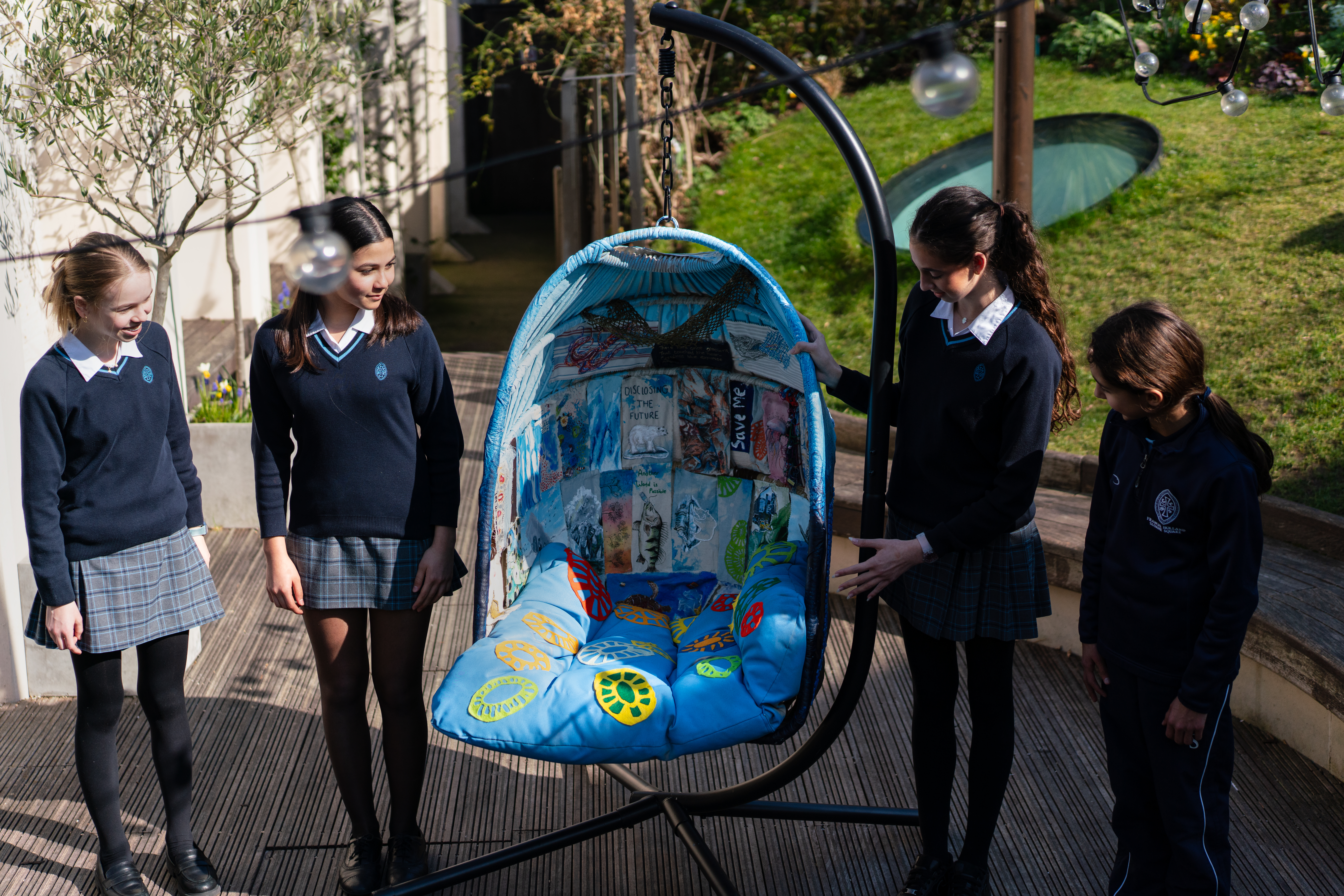
In partnership with climate charity Cape Farewell, the project ran for the duration of the 2024-25 academic year and explored environmental issues through multiple creative lenses, exploring how imagination can deepen knowledge and inspire action.
Climate education was transformed from theory into practice. Pupils not only learnt about different aspects and impacts of climate change but also how to apply this in real-world scenarios. By engaging in problem-solving activities, leadership opportunities and interdisciplinary projects, they developed critical thinking, teamwork and a sense of global responsibility. Teachers noted increased pupil curiosity and proactive discussions on environmental topics.
600 pupils took part in over 25 workshops, culminating in a summer exhibition featuring over 400 reflective artworks cutting across drama, art, dance, geography, music, poetry and photography, each representing a personal, distinctive response. Contributors included our pupils, Francis Holland Prep pupils, partner school pupils and world-renowned Cape Farewell artists. As one pupil noted, the project “helped me understand the impact I can make.” Another shared, “It changed my perspective completely, encouraging me to help the environment little by little.”
Daily immersion in our living Creative Perspectives gallery, featuring artworks by globally recognised contributors including Antony Gormley and Ian McEwan, created a powerful form of ambient learning. Climate issues were not confined to lessons but became part of pupils’ everyday experience.
A climate lens was applied to lessons, performances, exhibitions and everyday decisions, from concert music to school lunch! English classes explored eco-criticism; science investigated atmospheric and marine systems; geography examined global inequalities; art and drama enabled pupils to respond through sculpture, installation and performance.
The resulting pupil-curated exhibition wove together disciplines to create a powerful narrative, fostering community-wide collaboration and leadership. Cross-year mentoring enabled younger pupils to learn from older role models, while partnerships with parents and other schools broadened dialogue and perspectives.
Teachers have reported richer cross‑curricular dialogue, noting: “Eco‑criticism feels far more credible now that students have studied climate change through art, science and literature.” Pupils echoed this: “I’ve developed a different understanding of climate change – it’s not just science, it’s stories, feelings and creative responses.”
Cape Farewell are now partnering with other schools across the UK and the US using this blueprint.
This forms part of a wider focus on sustainability, whereby our pupils are taught the importance of treating our planet with consideration and respect, holding themselves and others accountable, and acting with integrity and responsibility. These principles are as applicable to cultivating healthy relationships with others as they are to cultivating the beauty and wonder of the planet we are so lucky to call our home, and our deeply relational approach to education at FHS ensures our pupils truly understand the importance and synchronicity of both.
The twin pillars of our sustainability agenda are reducing our own carbon footprint and educating pupils on the climate and ecological crisis. Annual sustainability events include two Walk-to-School Weeks, a Fast Fashion Free Week, a Sustainable Food Week and our Year 9 Earthshot Prize. Our Sustainability Prefects and Eco Reps deliver talks and Life Skills sessions on key areas including UN Sustainable Development Goals and air pollution, as well as launching competitions, events and initiatives.
As well as multiple clubs, we offer extensive enrichment options. For example, a group of Year 10s worked closely with Global Reef, a marine conservation organisation, to design artificial reefs to combat the effects of coral damage. Our crab design was crowned winner and the Francis Holland Crab has now been built and is proudly sitting in the bay of Koh Tao, Thailand, as part of a global research project into the resilience of coral from large-scale bleaching incidents.
We segregate all food waste, which is taken to an anaerobic digester to be turned into farm fertiliser, enabling us to measure our ‘plate waste’ more accurately each week and act to reduce it. Between September 2025 and April 2026, overall food waste has decreased by 43%.
The opening of our new Dining Hall in September 2026 has further revolutionised our sustainability provision, enabling us to offer many more co-curricular events, clubs, partnerships and activities that inspire our pupils to appreciate the importance, the creativity and the satisfaction derived from living sustainably. The ‘greenification’ of our school playground – another exciting development to our campus masterplan – will yield yet more of these opportunities.
We are very grateful to all the pupils, staff and members of our wider FHS community who contributed to the achievement of this award – a real team effort – and to School House for recognising the strength of our programmes.