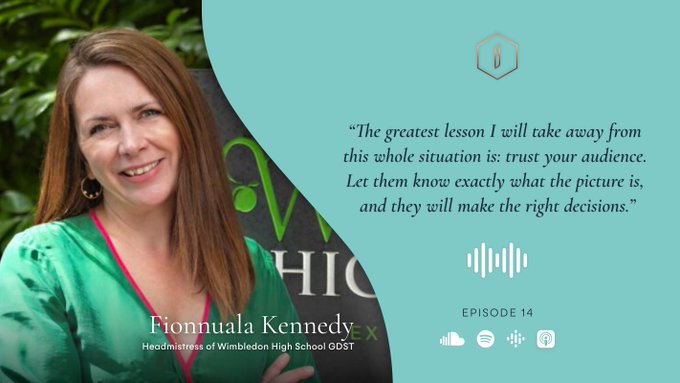

Fionnuala Kennedy, Head, Wimbledon High School, GDST
As a 44 year old woman with very Celtic skin – rosacea, complete inability to tan, ever-increasing lines, folds and wrinkles – I do sometimes think about skincare, and probably spend more on it now than I have done before. I wouldn’t go so far as to say I had a ‘routine’, but I cleanse and moisturise, and occasionally if half-heartedly use an exfoliating scrub, just to show willing. I know that these products cannot do very much if anything in terms of improving how I look, let alone making me seem younger than I am which we are told is their key aim, and I also know they are over-priced and over-packaged. Yet I do it anyway, partly because I feel I should and partly because, all critical thinking aside, I do occasionally fall for the pipe-dreams being sold to me of shinier, bouncier, fresher skin which will change not only how I look but also how I feel about myself.
Why am I writing this now? It’s fair to say I never dreamed that I would write about moisturiser in any format, let alone a professional one. But over recent years, and certainly since the pandemic, in my role as Head of a girls’ school, I have noticed a sharp interest developing amongst the student body in beauty products and especially skincare. And I’m not talking about the Neutrogena or tea tree face washes of the nineties which you’d pick up from Superdrug for £3.50 before going to bed with toothpaste on your spots and your fingers firmly crossed: girls as young as 11 are now craving the types of high-end, expensive creams and cleansers my generation would only ever have associated with their mothers, and even then probably only as a Christmas gift. Such products were formerly marketed at middle-aged, earning women led to believe that they must seek to defy the ageing process and who had access to disposable income; now, thanks to what have become known as ‘skinfluencers’, it is no longer just about turning back the clock (bad as that in itself is), it’s about cashing in on a tween and teen market filled with anxiety about their adolescent selves and keen to ‘correct’ what they perceive as aberrant about their looks.
Women have always been the target of the beauty and diet industries, convinced as we have been for millennia that youth is to be pursued at all costs and that our bodies must conform to a requisite standard. But this new trend of a cynical and deliberate push to a young and impressionable audience of children is – to use Marina Hyde’s apt term – bleak. Indeed, Hyde tweeted this in December:
If you were in Westfield White City Sephora last Friday and heard a really fun woman saying to her 10-year-old daughter “you are literally inviting the boot of the patriarchy onto your neck”, that was me! I’m here all week – here for all eternity in fact!
Hyde expanded on this in her ‘The Rest is Entertainment’ podcast, and I share her expression of disbelief and despair that such young girls are not only being cynically manipulated to see themselves as in need of any products, but that they are being propelled at such a young age into wasting time, effort and money in response to corrosive messaging that how they look naturally simply isn’t good enough. It’s incredibly sad. Add to this the current craze of already slim women in the public eye – many of them role models to these very same girls – injecting weight loss medication to allow them to access the thinnest version of themselves possible, and one wonders what chance young girls have of growing up to be comfortable in their skin, to accept themselves for who they are, and to embrace and champion difference or imperfection in themselves and others.
All of this worries me, intensely. But it rests on a more fundamental bedrock, I believe, of the constant, online messaging about ‘self-care’ and ‘self-improvement’ which all plays into the hands of the corporates in this industry. Had a bad day? Well you need to take care of yourself. So, light a pricey scented candle, pour expensive bath oil into the tub, rub yourself in £100 a bottle body lotion, use four or five different face creams at £40 a pop, and you’ll feel better.
I’m not a fan of the ‘new year, new you’ world of gruelling and unsustainable January fitness regimes (and certainly not of restricted eating – that’s a whole other blog…) but in the spirit of fostering new habits, at the start of 2025, it does feel time for a collective reset, to open our eyes to the pressure our girls (and indeed boys) are under from marketing powers far stronger than they are. Saying no to increasing demands for expensive products, talking to young people about what they are watching on YouTube / TikTok and why – and in particular gaining an understanding of the ‘skinfluencers’- whilst as adults modelling ourselves the true self-love which allows us to be accepting of our bodies: all of this will help our tweens and teens to be breathing air which is liberating and empowering as they grow up, learning to love and accept themselves as well as other people. And, to my mind, nothing could be more important than that.