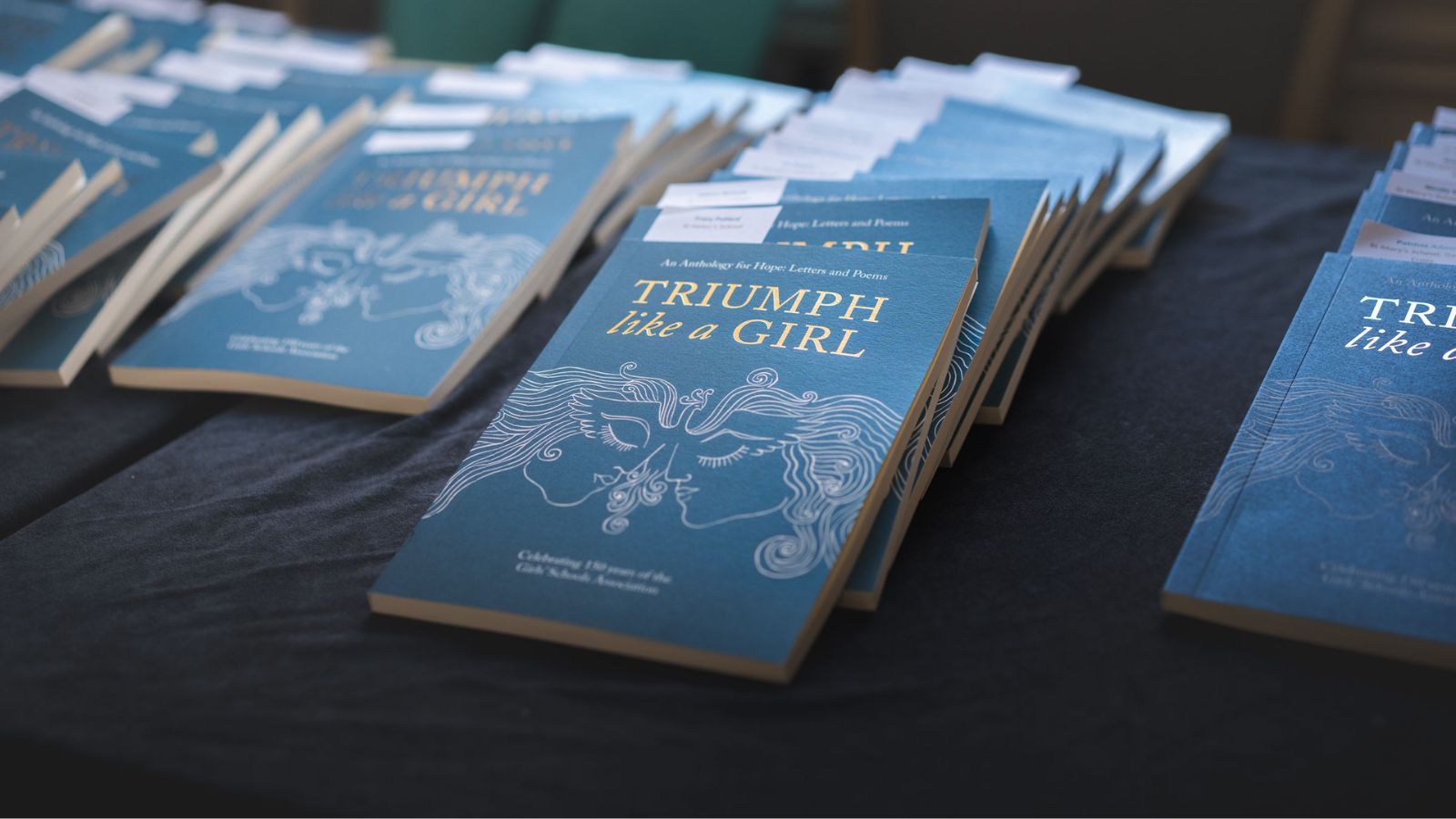
Triumph like a Girl An Anthology for Hope: Letters and Poems celebrates the 150 year anniversary of the Girls’ Schools Association.
Taking its name from the 24th Poet Laureate of the United States Ada Limon’s poem ‘How to Triumph Like a Girl’, and curated and edited by Dr Karen McCarthy Woolf, FRSL, for the first time in the Association’s history it gathers the voices of women, girls, and allies of girls’ schools and education together.
Made up of selected letters from GSA Heads, colleagues in education and alumni; and students’ haiku and haibun from shortlisted and winning entries from its GSA member schools annual writing competition the book is offered as a gift to GSA Members and contributors as part of its landmark year.
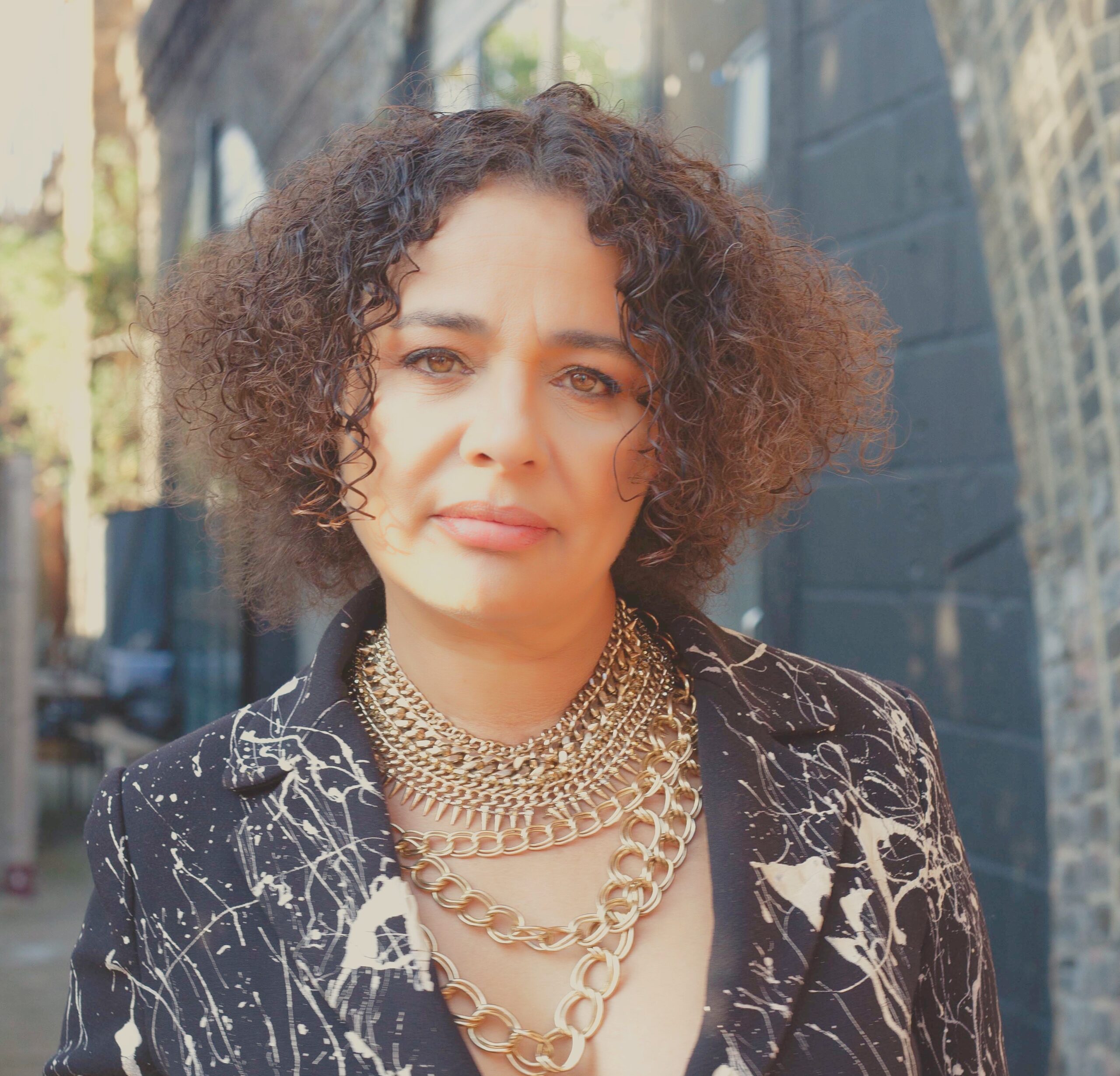 As Karen writes in her introduction: “I was touched by the many pieces which spoke to a shared passion for learning, teaching, and an intergenerational collegiate spirit. Where to triumph like a girl is ‘to collaborate rather than compete’ and to occupy a space where girls’ ambitions know no limits.”
A reprint of the books is currently under consideration for a small cost per book plus P&P. Anyone interested in copies should contact [email protected] to be added to this number.
This book also highlights the collaborative partnerships between educational Associations and brings to life their shared histories. Professor William Richardson (University of Exeter) is both honorary fellow and archivist at the Association of School and College Leaders (ASCL). He is a widely published historian of education and, during 2011-18, was General Secretary of the Heads Conference (HMC) and has himself written two unique letters in conversation with one another for GSA, featured here.
On the Education of Girls: Letters between the Present (2024) and the Past (1900)
A Letter from the Present to the Past
Dear Educators of Girls in 1900,
Although it’s now the 2020s, we think we know something about the schools you built in the late 1800s, the battles you fought and the barriers you overcame.
Of course, we can only know part of your stories but, from what we do know, we stand with the spirit of your aims and ideals, and hope that you would recognise and stand with some of ours.
In our present age, we want every girl, everywhere in the world, to have a secondary education.
And in our own country, we want a rising generation of girls and young women out in the world to feel secure and safe, with each equipped by upbringing and education to find their own path to adult fulfilment.
We think you would approve of these ideals but can’t be certain. We wish more of your stories had come down to us, since many that have been preserved are a source of inspiration.
Is there more we can and should understand?

With kind regards,
William Richardson (a seeker of clarity about the past)
A reply from the Past (1900) to the Present (2024) and beyond
Dear William Richardson,
Yes. We believe that if we’d lived that long, we would, in the 2020s, have come to stand behind your goals. More than that, we think that your ideals extend the goals for which we fought.
It has fallen to us to image and devise what secondary education for girls might look like, and then to persuade our contemporaries here, in the 1880s and 1890s, to help bring it about. Perhaps this is a legacy that will help you, in your own time, realise something of which we, in 1900, can only dream: the right of all girls, everywhere in the world, to an extended education.
For us, establishing schools for girls is just the beginning. We are now creating a new secondary curriculum designed to open up careers for girls across all occupations, but not all parents in our time have yet learned to value such opportunities for their daughters. We also dream that girls in Britian will be able to draw upon their education as full citizens, with an electoral vote equal to that of men.
Perhaps we and our allies can, in time, achieve these goals – secondary education for all girls and full enfranchisement. If we do, we hope that some of the ideals and ambitions for girls in your own age will be made easier to achieve.
Be in no doubt, you will need to battle in your time as hard as we have done in ours. But if you do, you and your allies will pass on a legacy of achievement from which your successors can draw, as they face the yet-unknown dilemmas and opportunities of their own time.
With our good wishes,
The forward-looking educators of girls, in 1900 (builders of tomorrow)
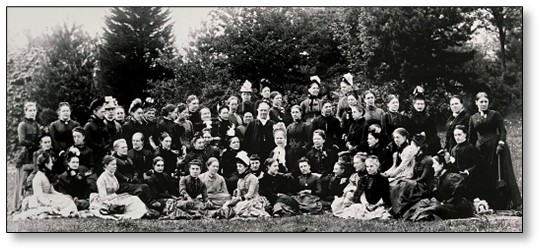 (Image: The Association of Head Mistresses annual meeting held, in June 1887, at Uppingham School, Rutland. © Uppingham School)