
The decisions families make at age four have a longer tail than most people expect. New research and decades of evidence suggest that the environment a girl learns in during her primary years shapes her relationship with ambition, with difficult subjects, and with her own ability long before she sits an exam.
When Frances Mary Buss founded North London Collegiate School in 1850, her central argument was straightforward: girls deserved the same academic education as boys, and they were fully capable of it. That idea was radical at the time. But one hundred and seventy-six years later, it is the founding principle of a school that has been named Independent Secondary School of the Year by the Sunday Times, and whose Junior School sits on the same 30-acre campus, sharing facilities, a culture, and the same refusal to set a ceiling on what its girls can achieve.
The question families increasingly ask is not whether girls’ schools are necessary, but when the benefits begin to take shape. The answer, according to both the research and the evidence from schools like ours, is much earlier than secondary level.
New research from the Girls’ Schools Association, puts hard numbers on outcomes that are already visible in girls schools. Girls at single-sex schools are 2.9 times more likely to take Further Mathematics at A level, 2.2 times more likely to take Physics, and 2.1 times more likely to take Computer Science (GSA, 2026) . These numbers represent a different relationship with STEM subjects, one that has to be built over time, and one that the junior years play a direct role in creating.
What a girls only environment actually does
The most immediate effect is structural. In a school where every student is a girl, every leadership role, every top mark, every captaincy belongs to a girl. There is no gendered signal attached to any subject because the reference group is entirely female. For girls in the junior years, who are forming their sense of what is normal and what is possible, that is no small thing.
Recent research found that girls in single-sex settings are more willing to seek help, more likely to participate in class discussion, and less likely to experience the social pressures that come with mixed-gender peer dynamics (GDST, 2024)
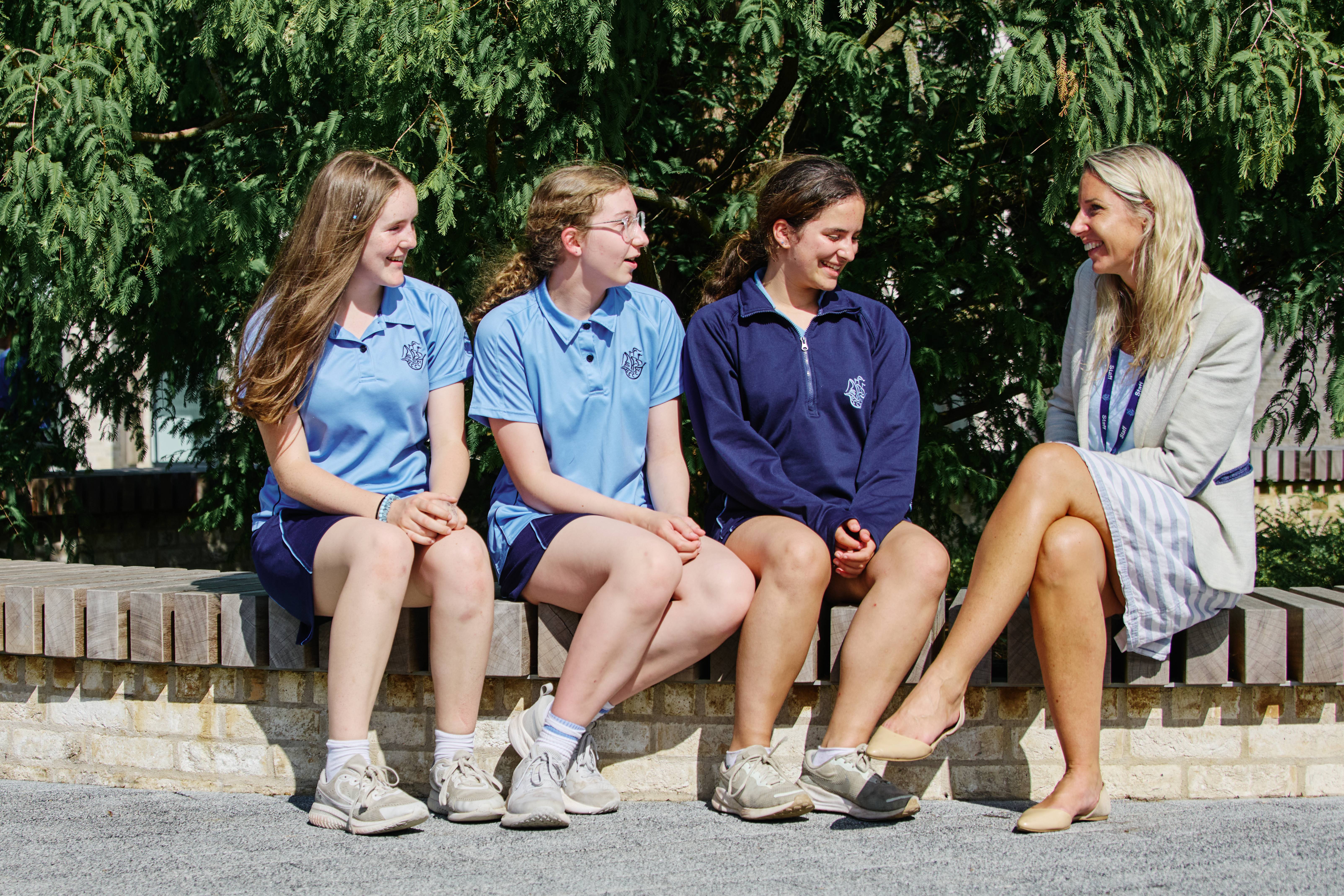
NLCS Junior School takes girls from Reception through to Year 6 on the same campus as the senior school, and that continuity is deliberate. The junior years are treated as the years in which intellectual habits and confidence are formed, not a warm up for what comes next. By Year 3, our girls are independently choosing from over 40 after school clubs that stretch their ability and build confidence outside the classroom. In Year 6, they start attending careers events such as ‘Women in STEM’, led by NLCS alumnae who sat in the same classrooms and went on to lead in their fields. That kind of representation offered early carries weight and shapes their sense of what is possible. Girls are also encouraged to find their own voice through independent research projects, where they develop and present their own ideas to an audience.
The argument for girls’ education is often made at secondary level, where results are easier to measure. But the evidence increasingly points to the junior years as the period when the foundations are laid. Confidence in all subjects, willingness to lead, comfort with being wrong and trying again: these are not things that suddenly appear at eleven. They are built, slowly, across the early years of school.
References:
Girls’ Schools Association. The Academic Attainment and Representation of Girls in STEM.
GDST. Why (and how) girls thrive in girls-only schools.